Article: Leather vs Vegan Leather: Durability, Cost and Environment Over 5 Years
Leather vs Vegan Leather: Durability, Cost and Environment Over 5 Years
Add Us as a preferred source on Google.
"Vegan leather" is a marketing term, not a material. It covers everything from polyurethane on a polyester backing to genuinely novel plant-based composites, and the difference between those two things is larger than the difference between either of them and animal leather.
This is a comparison over a five-year horizon, because that is where the two materials genuinely separate — and where most short comparisons stop before the interesting part.
What is actually in "vegan leather"
Three distinct categories get sold under one label:
- PU (polyurethane) — a plastic coating on a fabric backing. The overwhelming majority of vegan leather products. Softer and more breathable than PVC, and the standard for "vegan leather" bags.
- PVC — older, stiffer, less breathable, environmentally worse. Still common at the bottom of the market.
- Plant-based composites — cactus, pineapple leaf, apple waste, mushroom mycelium. Genuinely innovative, and the reason the category gets favourable coverage. Almost all of them are still bonded to or coated with polyurethane to achieve durability, so the plant content is a percentage rather than the whole material.
When an article praises vegan leather's sustainability, it is usually describing category three. When you buy a vegan leather bag, you are usually buying category one.
Durability over five years
This is the decisive difference and it is not close.
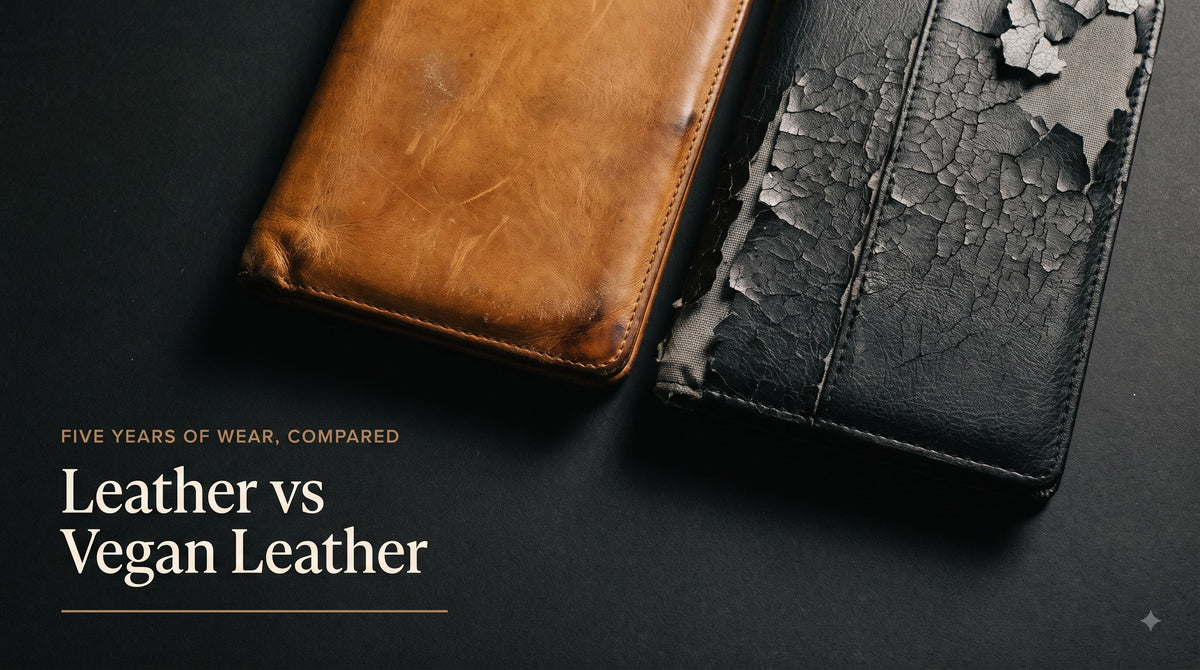
PU delaminates. The plastic layer is bonded to a fabric backing, and that bond degrades — through flexing, heat, humidity and UV. When it goes, the surface cracks and peels away in sheets, exposing the fabric underneath. It is not a repairable failure, because the material has separated from itself. Typical service life for a well-made PU bag in daily use is a few years, and Indian heat and humidity are not kind to it.
Full-grain and top-grain leather do not delaminate, because there is no coating bonded on top — the surface is the material. They scuff, darken, soften and develop a patina, and every one of those is normal ageing rather than failure. Structural components fail first: stitching, zips, fittings. All of those are replaceable.
One honest caveat: coated split — the grade sold as "genuine leather" — fails much like PU does, because it also has a finish layer bonded on top. So "leather lasts longer than vegan leather" is only true above a certain grade. Below it, the two are closer than leather sellers like to admit. Which grade you are holding is covered in how to identify real leather vs fake.
Cost over five years
Vegan leather wins at purchase and usually loses over the period, for a simple reason: replacement cycles. A bag replaced twice in five years at a lower price is often more expensive in total than one bought once, and it is certainly more expensive than one bought once and repaired.
The variable that decides it is whether the more expensive bag comes with a repair path. A ₹5,499 backpack that gets a new zip in year four and carries on is a different financial proposition from a ₹5,499 backpack that gets discarded when the zip goes.
The environmental comparison, honestly
Both materials have real problems and neither industry reports them neutrally.
Against leather: it is a livestock by-product, so it carries an association with the emissions and land use of cattle farming. Tanning is chemically intensive, and untreated tannery effluent is a serious pollutant.
Against PU vegan leather: it is a petrochemical product. It does not biodegrade meaningfully; it fragments into microplastics. Its production is not clean, and a short service life multiplies the impact — a material replaced three times over the period a leather bag lasts has been manufactured and shipped three times.
The honest position is that the comparison depends almost entirely on production standards and service life, not on the category. A leather bag from a tannery running Zero Liquid Discharge — treating and recycling process water so essentially no effluent leaves the site — that lasts fifteen years is a very different object from an untreated-effluent leather bag that lasts four. Ours has run ZLD since 1996; more on that in vegetable-tanned vs chrome-tanned leather.
What no material comparison can settle is the ethical question of using animal products at all. That is a values decision, and it is not ours to argue anyone out of. If it is the reason you are choosing vegan leather, durability tables are beside the point — buy the best-constructed PU bag you can and replace it when it goes.
Feel, appearance and ageing
- New: good PU is convincing. Uniform, consistent colour, often lighter in weight.
- Year one: leather softens and moulds to use. PU stays exactly as it was.
- Year three onward: leather develops patina — darkening at the handles, character at the corners. PU begins to show wear at flex points as surface cracking.
- Year five: leather generally looks better than it did new. PU is usually peeling somewhere.
That divergence is the whole argument. Leather is a material that improves with handling. PU is a material that is at its best in the photograph.
Which to buy
Choose vegan leather if you do not want animal products, if you want the lowest purchase price, if you need a bag for a season or a specific look, or if you want something very light.
Choose leather — full-grain or top-grain specifically, not "genuine" — if you want one bag for a decade or more, you want it to age rather than degrade, and you want failures to be repairable rather than terminal.
And if you choose leather, ask the grade, ask the source and read the warranty. Ours is a Lifetime Service Warranty: claims reviewed in 24 to 48 hours, repairs in four to five working days, return shipping on us.
Frequently asked questions
Is vegan leather as durable as real leather?
Generally no. Most vegan leather is polyurethane bonded to a fabric backing, and that bond degrades over a few years until the surface cracks and peels — a failure that cannot be repaired. Full-grain and top-grain leather have no bonded coating and age rather than delaminate.
Is vegan leather better for the environment?
It depends on production standards and service life rather than on the category. Most vegan leather is a petrochemical product that fragments into microplastics and is replaced more often, while leather's impact hinges on livestock association and tannery effluent treatment.
What is vegan leather made of?
Usually polyurethane on a fabric backing, sometimes PVC. Plant-based versions using cactus, pineapple leaf, apple waste or mycelium exist, but nearly all of them are still bonded to or coated with polyurethane for durability.
How long does a vegan leather bag last?
A well-made PU bag in daily use typically lasts a few years before the surface begins to crack or peel, and heat and humidity shorten that. The failure is in the bonding layer, so it cannot be repaired.
Does real leather peel?
Full-grain and top-grain leather do not peel, because the surface is the material rather than a coating. Coated split — sold as "genuine leather" — does peel, in much the same way polyurethane does.