How to Identify Real Leather vs Fake: 7 Tests You Can Do in a Shop
Add Us as a preferred source on Google.
Walk into any market in Delhi, Mumbai or Chennai and you will be told the same thing about every bag on the shelf: "Sir, this is pure leather." Some of it is. A lot of it is coated split, bonded scrap, or polyurethane pressed with a grain pattern.
The tests below are the ones our own quality team uses on the tannery floor in Kanpur. None of them need equipment. All of them can be done standing in a shop before you pay.
First, understand what the label is not telling you
"Genuine leather" sounds like a guarantee. It is not. In leather grading it is a specific tier — and a low one. It refers to the inner split layers left after the strong outer grain has been cut away, usually sanded, coated and embossed with a fake grain. It is real animal hide, so the label is not a lie. It is just the weakest usable part of it.
The hierarchy, strongest first:
- Full-grain — the complete outer layer with its natural grain intact. Nothing sanded off. Strongest fibres, develops a patina, lasts decades.
- Top-grain — the outer layer lightly sanded to even out marks, then finished. Slightly less durable than full-grain, more uniform in appearance.
- Genuine leather — inner splits, coated and embossed. Typically two to five years of daily use before it cracks or peels.
- Bonded leather — leather dust and scraps glued onto a backing. Behaves like plastic. Avoid.
So the question to ask a seller is never "is this genuine leather?" It is "which grade is this?" A seller who cannot answer, or who repeats "genuine" as though it settles the matter, is telling you something either way.
Seven tests you can do in a shop
1. Look at the pores
Real hide has an irregular pore pattern. No two square inches are identical, because no animal grows a repeating skin. Synthetic grain is stamped from a plate, so the pattern repeats. Find a flat panel, look closely, and scan for a repeat. If you can spot the same cluster of pores twice, it is embossed.
2. Check the edges
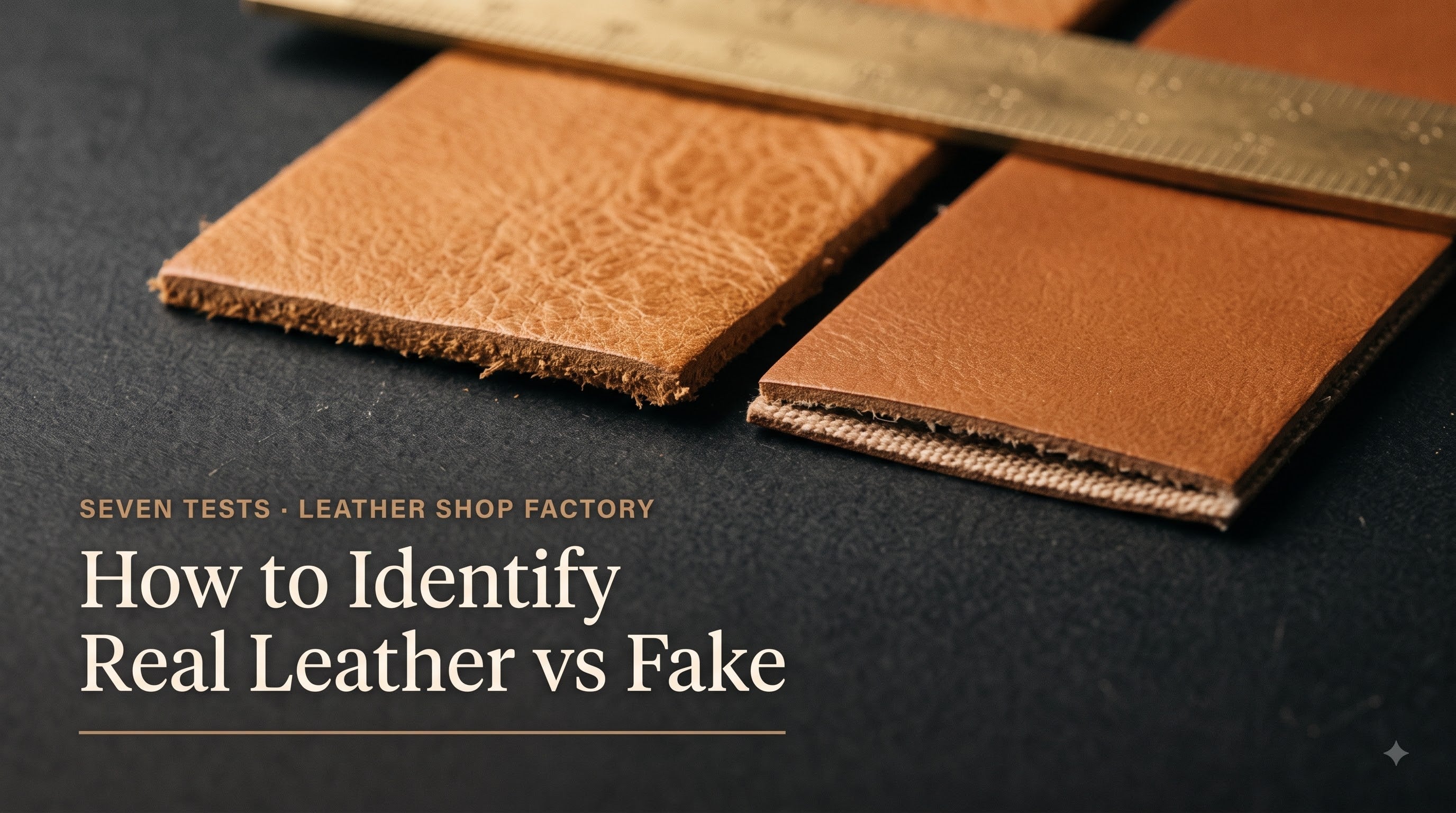
This is the fastest reliable test. Cut leather has a fibrous, slightly fuzzy edge — you can see the compressed fibre structure. Synthetic has a clean, sealed edge, often with a visible fabric or mesh backing underneath the coating. Many bags paint their edges, so look where the edge is unfinished: inside a pocket, under a strap, at a seam.
3. Press it with your thumb
Press firmly into a flat area. Real leather creases and wrinkles around your thumb the way skin does, then relaxes back. Synthetic resists, stays smooth, or dents and holds the dent. Full-grain leather in particular will stretch slightly under pressure and recover.
4. Smell it
Tanned hide has a rich, slightly sweet, unmistakable smell. Synthetic smells of chemicals or of nothing. This test is less reliable than it used to be — some coatings are scented deliberately — but a plastic smell is still a definitive no.
5. Feel the temperature
Rest your palm flat on the surface for a few seconds. Leather is a natural insulator: it warms to your body temperature and feels dry. Synthetic stays cool at first, then feels clammy because it does not breathe.
6. Look at the back
Turn the material over wherever you can — inside an unlined pocket, under the flap. The reverse of real leather is suede-like and fibrous. The reverse of synthetic is woven fabric, because that is the backing the plastic was coated onto.
7. Check the water drop
If the shop allows it, put a single small drop of water on an inconspicuous spot. Untreated or lightly finished leather absorbs it slowly and darkens, then dries back. Heavily coated leather and synthetic bead it off entirely. This one needs judgement — a well-finished full-grain bag is meant to resist water — so treat it as supporting evidence, not proof.
The burn test, and why not to do it in a shop
You will find the burn test in every online guide: real leather smells of burnt hair and chars, synthetic melts and smells of plastic. It is accurate. It is also destructive, and no seller will let you set fire to their stock. It belongs to material you already own, on a hidden offcut, not to a purchase decision.
What none of these tests tell you
Every test above distinguishes leather from synthetic. Not one of them reliably distinguishes full-grain from a well-finished split. A coated genuine-leather bag passes the smell test, the temperature test and often the pore test, because it is real hide with a fake grain pressed on top.
That distinction is the one that decides whether your bag lasts three years or twenty — and it cannot be resolved by touch. It can only be resolved by a seller who will state the grade plainly and stand behind it in writing.
Which is the practical test: ask what happens when it fails. A brand that knows its own grade will tell you the grade, the tannery, and the warranty terms without hesitating. A brand selling coated split will talk about "premium quality" and change the subject.
Where our own leather comes from
We are unusual in Indian bag retail in that we are not buying finished leather from a trader. Our family has tanned in Kanpur since before 1996, moved the facility to Zero Liquid Discharge standards in 1996, expanded it in 2007, and opened a second tannery in Kolkata in 2018. Most Indian bag brands outsource their hide and take the supplier's word on grade. We cut ours.
That is why our products are described by grade rather than by the word "genuine": full-grain aniline on the Roman and Vesper backpacks, top-grain crunch across the wallet range, NDM on the structured laptop bags. If you want the difference between the top two grades in detail, we wrote that up separately in full-grain vs top-grain leather.
And every bag we sell carries a Lifetime Service Warranty — claims reviewed within 24 to 48 hours, repairs in four to five working days, return shipping paid by us. That is the answer to "what happens when it fails," in writing.
Frequently asked questions
Is "genuine leather" real leather?
Yes, it is real animal hide — but it is the lowest usable grade, made from the inner split layers after the strong outer grain has been removed. It is typically coated and embossed with an artificial grain, and lasts around two to five years in daily use.
What is the quickest way to tell real leather from fake?
Look at an unfinished edge. Real leather shows a fibrous, slightly fuzzy cut edge; synthetic shows a sealed edge with a fabric backing beneath the coating. Check inside a pocket or under a strap where the edge has not been painted.
Does real leather always smell like leather?
Genuine hide has a distinctive rich smell, but some synthetics are deliberately scented to imitate it. Use smell as one signal among several — a clear plastic or chemical smell rules leather out, but a leather smell alone does not rule it in.
Can you tell full-grain from genuine leather by touch?
Not reliably. A well-finished split is still real hide and passes most physical tests. The grade has to come from the seller, which is why it is worth buying from a brand that states the grade and the tannery in writing.