Vegetable-Tanned vs Chrome-Tanned Leather: What Actually Differs
Add Us as a preferred source on Google.
Tanning is the step that turns a raw hide into leather — a material that will not rot, stiffen or fall apart. Essentially all leather is tanned one of two ways, and the difference between them explains most of what people notice about how a leather bag ages, smells, costs and feels.
What tanning actually does
A raw hide is protein. Left alone it decomposes. Tanning permanently alters the collagen structure so it becomes stable — resistant to water, heat and bacteria. Everything else, colour, softness, finish, happens afterwards.
The two methods differ in what does the stabilising.
Vegetable tanning
Vegetable tanning uses tannins drawn from bark, leaves and other plant matter. Hides soak in progressively stronger tannin baths, traditionally in pits, over a period usually measured in weeks to months.
What you get:
- Firm, dense leather that holds shape well. It is the standard for belts, saddlery, and structured goods.
- A patina. Vegetable-tanned leather darkens and develops character with sunlight, oils from your hands and use. This is the material people mean when they talk about leather ageing beautifully.
- Warm natural tones — tans, browns, russets. Bright colours are difficult.
- The classic leather smell, which comes from the tannins.
- Sensitivity to water, at least initially. It stains and darkens where it gets wet.
The cost follows the timeline. Months of processing, pit space and skilled handling make it the expensive option, and it accounts for a small minority of world production.
Chrome tanning
Chrome tanning uses chromium salts, principally chromium sulphate, in rotating drums. It takes about a day rather than months, and it is how the large majority of the world's leather is made.
What you get:
- Soft, supple leather straight out of the process, which is why it dominates garments, upholstery and most bags.
- Water and heat resistance that is better from the start.
- Any colour, reliably and consistently across batches.
- Consistency — far less variation hide to hide, which matters when you are producing a run of identical bags.
- Less dramatic ageing. Chrome-tanned leather wears well but does not develop the deep patina vegetable-tanned leather does.
The environmental question, without the marketing
This is where most articles become unreliable, in both directions.
Vegetable tanning is not automatically clean. It is water-intensive over a long cycle and produces high-organic-load effluent. An uncontrolled vegetable tannery discharging into a river is a real pollution problem.
Chrome tanning is not automatically dirty. The chromium used in tanning is trivalent chromium, which is not the hexavalent compound that carries the serious toxicity profile. The risk is that trivalent can oxidise to hexavalent under poor process control, and that untreated chrome effluent is genuinely damaging. Both risks are process failures, not inevitabilities.
The variable that actually determines environmental impact is effluent treatment, not the choice of tannin. A chrome tannery running Zero Liquid Discharge — treating and recycling its process water so essentially no liquid effluent leaves the site — has a smaller footprint than an unregulated vegetable operation discharging into a waterway.
Our own facility moved to ZLD standards in 1996 and has run that way since, through the 2007 expansion and the opening of the second tannery in Kolkata in 2018. That is the part of our process we would point at, rather than the tannin. More on the Indian context in is Indian leather good quality.
How to tell which one you are holding
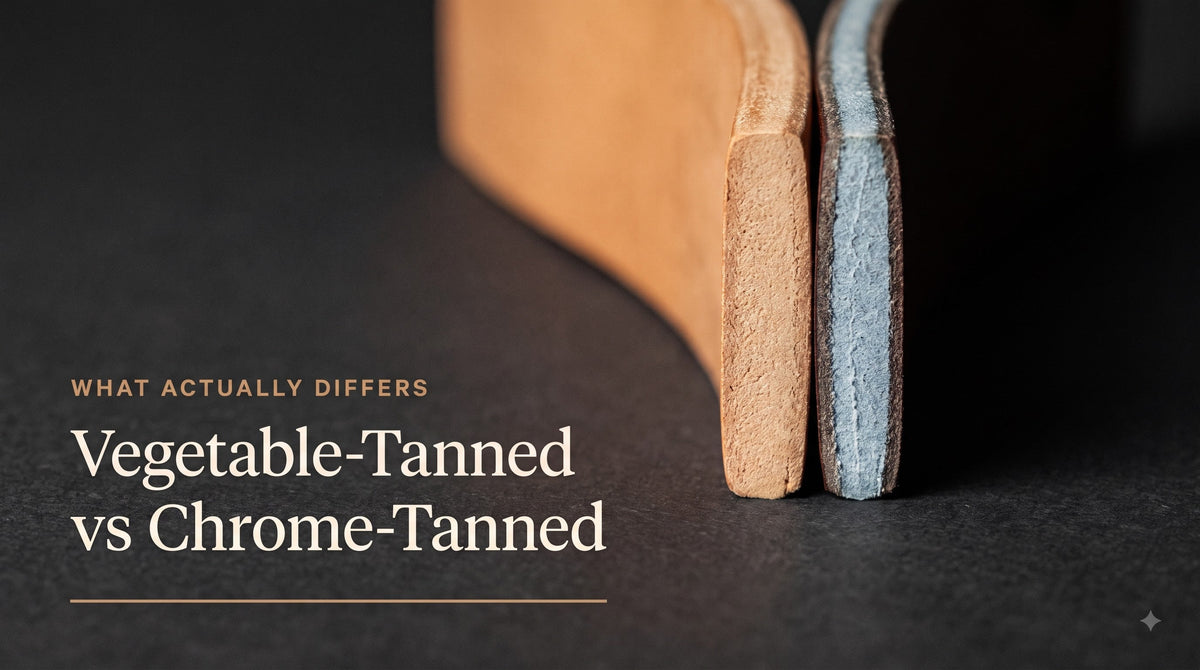
- Cut edge colour. Vegetable-tanned leather is a consistent beige or tan through the cross-section. Chrome-tanned leather typically shows a pale blue-grey core — a residue of the process, and the most reliable single indicator.
- Firmness. Vegetable-tanned is stiffer and holds a fold. Chrome-tanned is supple and drapes.
- Smell. Vegetable-tanned has the strong, sweet, classic leather smell. Chrome-tanned smells fainter and more neutral.
- Colour range. A bright blue or red leather is almost certainly chrome-tanned.
Which should you buy?
Neither is better in the abstract. They suit different objects.
Vegetable-tanned if you want a piece that visibly ages into something personal, you prefer structure over softness, natural tones suit you, and you will keep it out of heavy rain. Belts, structured bags, wallets you intend to carry for decades.
Chrome-tanned if you want softness immediately, need a specific colour, want better water resistance from day one, or are buying something that must look identical to the photograph.
Note that tanning method and grade are separate questions, and grade matters more for durability. A chrome-tanned full-grain hide will outlast a vegetable-tanned split every time. Grades are covered in full-grain vs top-grain leather.
Across our own range, the Roman and Vesper backpacks are full-grain aniline treated with natural oils and waxes; the wallet range and the Crocelite Laptop Bag are top-grain crunch leather.
Frequently asked questions
What does vegetable-tanned leather mean?
It means the hide was stabilised using tannins from bark, leaves and other plant material, in a process that typically takes weeks to months. The result is firm leather that develops a patina and carries the classic leather smell.
Is vegetable-tanned leather better than chrome-tanned?
Neither is universally better. Vegetable-tanned is firmer, ages into a patina and suits structured goods; chrome-tanned is softer, more water-resistant, available in any colour and far more consistent. Leather grade affects durability more than tanning method does.
Is vegetable-tanned leather vegan?
No. Vegetable tanning refers only to the plant-derived tannins used in processing — the material is still animal hide.
Is chrome-tanned leather toxic?
Leather made by chrome tanning uses trivalent chromium, which does not carry the toxicity profile of hexavalent chromium. The environmental concern is with untreated tannery effluent and poor process control, which is why effluent treatment standards such as Zero Liquid Discharge matter more than the tanning agent itself.
How can I tell if leather is vegetable-tanned?
Look at a cut edge. Vegetable-tanned leather is an even beige or tan right through the cross-section, while chrome-tanned leather usually shows a pale blue-grey core.