Best Leather Wallets for Men in India: How to Choose
Add Us as a preferred source on Google.
Most "best wallet" lists in India rank products the writer has never held, by price alone. This one does something narrower and more useful: it explains the four decisions that actually determine whether a leather wallet lasts, and then shows how our own four wallets differ from each other so you can pick the right one rather than the cheapest one.
The four decisions that matter
1. Grade, not the word "genuine"
A wallet lives in a back pocket, gets sat on, flexes several hundred times a week and absorbs sweat. It is the hardest-worn leather item most people own. Grade decides whether it develops a patina or starts peeling at the fold.
"Genuine leather" is not a compliment — it is the low grade, made from inner splits, coated and embossed. In a wallet, that coating is what cracks along the crease within two or three years. Top-grain and full-grain do not have a coating to crack. If a listing will not name the grade, assume the answer is the one that does not sell.
All four of our wallets are top-grain crunch leather. Not one of them is coated split.
2. Card count against actual bulk
Card capacity is the specification everyone reads and few people match to their life. Count what you genuinely carry — most Indian professionals run four to eight cards plus an ID and some cash. Buying a twelve-slot wallet for six cards produces a half-empty brick; buying a six-slot wallet for ten cards means cards stacked two deep, which stretches the slots permanently.
3. Cash compartment design
Indian notes are longer than US bills and the ₹500 sits differently from a ₹100. A single deep compartment handles mixed denominations without folding; two compartments let you separate notes from receipts. Neither is better — but a wallet with no dedicated cash section is designed for a card-only market, not this one.
4. What happens when it fails
Stitching gives out before leather does. A wallet with a real repair path outlives one without, regardless of grade. Ask for the warranty document, not the reassurance.
Our four wallets, compared honestly
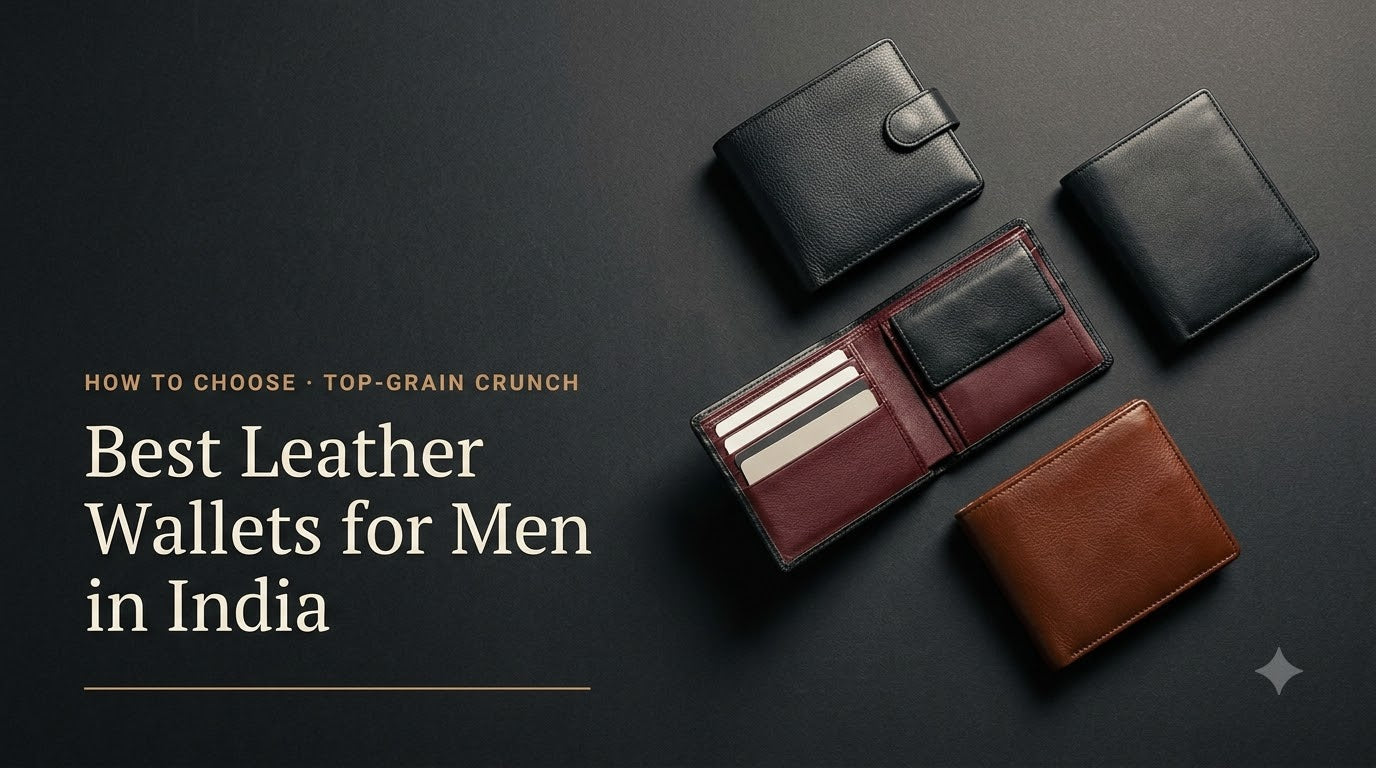
They are close in price and share the same material. The difference is layout, and the right one depends on what you carry.
Callow Wallet — ₹1,149
The Callow carries six card slots, two ID holders and a dedicated cash compartment, closed with a snap strap lock. The two ID holders are the distinguishing feature — useful if you carry both a company access card and a government ID and want them visible without unfolding the wallet. The snap closure keeps the wallet shut when it is full, which matters more than it sounds if you carry loose receipts. Also in dark brown and green.
Fenn Wallet — ₹1,399
The Fenn is the slim one: six card holders, one ID slot, one cash compartment, in a deliberately compact profile. If your objection to leather wallets is that they bulk out a trouser pocket, this is the one in the range built against that. Fewest slots, least bulk. Available in black, brown, cherry red and green.
Rowe Wallet — ₹1,449
The Rowe takes eight card holders and two cash compartments while staying slim — the highest capacity-to-bulk ratio in the range. The interior is maroon against black leather. Choose this if you carry more cards than average but do not want the wallet to grow to match.
Drey Wallet — ₹1,499
The Drey also runs eight card slots and two cash compartments, in a more structured build. Where the Rowe prioritises slimness, the Drey prioritises holding its shape. It comes in the range's two-tone finishes — black and cherry, dark brown and forest green — and brown.
Choosing in one line each
- Fewest cards, slimmest pocket → Fenn
- Two IDs and a secure closure → Callow
- Most cards, still slim → Rowe
- Most cards, most structure → Drey
What we are not going to do
We are not going to rank ourselves above brands we have not tested, and we are not going to publish competitor specifications we cannot verify. If you are comparing across brands, the useful move is to apply the same four questions to each of them: what grade, from where, how many cards, and what is the warranty in writing. Most listings will fail the first question, which shortens the list quickly.
Ours are top-grain crunch leather, cut from hide tanned in our family's own Kanpur facility, and covered by a Lifetime Service Warranty: claims reviewed in 24 to 48 hours, repairs in four to five working days, return shipping paid by us. If a wallet's stitching goes at year six, that is our problem to fix.
If you want to sanity-check any leather purchase in a shop before paying, the physical tests are in how to identify real leather vs fake.
Frequently asked questions
Which leather is best for a men's wallet?
Full-grain and top-grain leather are both suitable, because neither has a surface coating that can crack along the fold. Coated split — sold as "genuine leather" — is the grade that typically fails at the crease within two to five years of daily use.
How many card slots should a wallet have?
Count what you actually carry. Most professionals use four to eight cards plus an ID. Fewer slots than you need forces cards to stack and stretches the leather permanently; far more slots than you need adds bulk with no benefit.
How much should a good leather wallet cost in India?
Top-grain and full-grain wallets from brands that disclose their grade generally start above the ₹1,000 mark. Below that price point, the material is usually coated split, which is why the same wallet needs replacing every few years.
Do leather wallets last?
A top-grain or full-grain wallet in daily use commonly lasts well beyond a decade, and stitching usually fails before the leather does. That makes a repair path — rather than the material alone — the practical difference between a wallet that lasts and one that gets replaced.